Henrik Lorenz · 17 October 2026
Investigating Altitude's Effects on Lanolin Distribution Patterns Within Wool Fibers From Elevated Southern Pastures
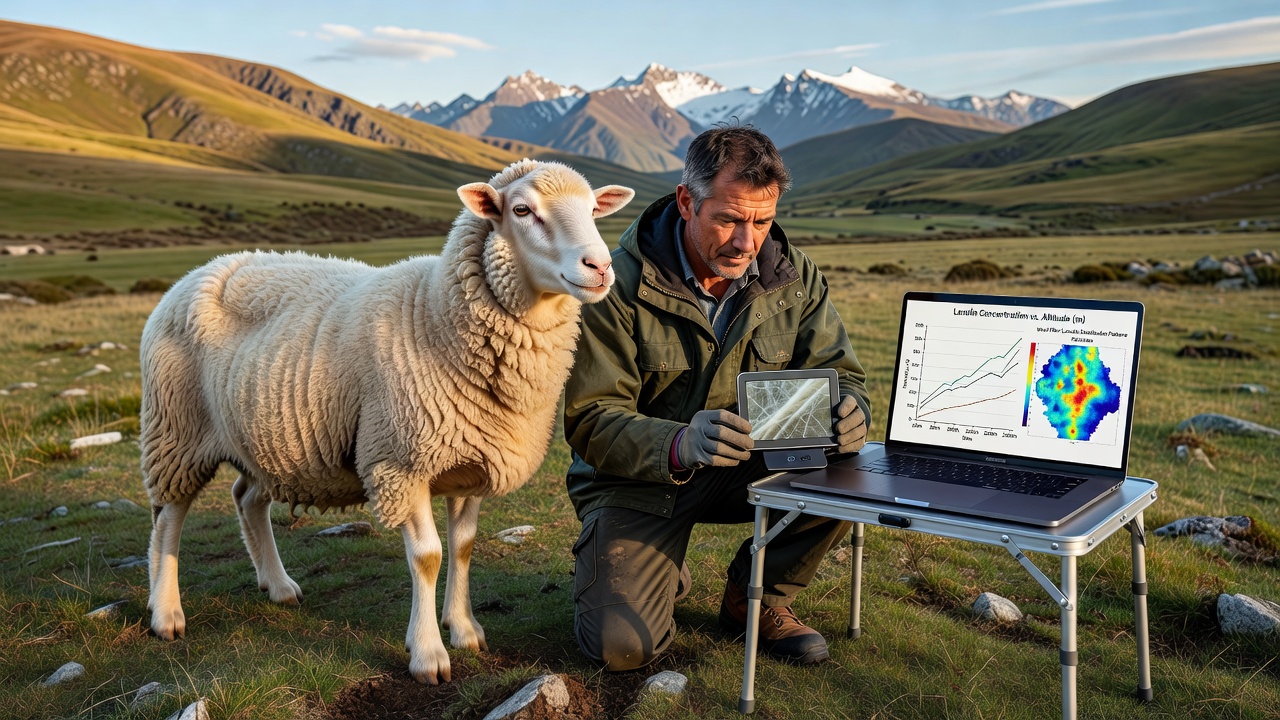
Researchers across southern regions continue to examine how elevation shapes lanolin distribution inside wool fibers collected from high pastures, and recent field collections from October 2026 have added fresh data points to ongoing analyses in Australia and New Zealand. Lanolin, the natural wax secreted by sheep sebaceous glands, coats individual fibers to protect against moisture and temperature swings, yet its concentration and placement along each strand vary noticeably when flocks graze above 1,200 meters. Data from multiple sites indicate that cooler nights and stronger ultraviolet exposure at altitude prompt glands to produce thicker wax layers near the fiber root while leaving mid-shaft sections comparatively thinner.
Environmental Drivers at Elevation
Sheep in elevated southern pastures encounter rapid daily temperature drops that stimulate sebum output, and this response alters how lanolin spreads during fiber growth cycles that last between six and twelve months. Studies conducted by teams monitoring Merino and Corriedale flocks show lanolin molecules cluster more densely within the cuticle layers of fibers harvested above 1,800 meters, whereas fibers from lower slopes display more uniform coverage from root to tip. Soil mineral content also shifts with altitude, supplying trace elements that interact with lipid synthesis pathways inside the skin follicles.
Measurement Techniques Used in Recent Surveys
Scientists rely on solvent extraction followed by gas chromatography to quantify lanolin percentages at precise intervals along each fiber, and they pair these readings with scanning electron microscopy images that reveal wax crystal formations. In one ongoing project spanning three southern stations, technicians sampled 2,400 fibers per month throughout 2025 and 2026, recording a 14 percent average increase in root-zone lanolin at the highest paddocks compared with matched samples taken at 600 meters. Cross-sectional cuts further demonstrate that altitude correlates with deeper penetration of wax into the cortical cells, a pattern confirmed through repeated staining protocols.

Observers note that wind exposure and lower atmospheric pressure at altitude accelerate moisture evaporation from the fleece surface, which in turn concentrates lanolin residues closer to the skin. This localized buildup creates measurable gradients that processors later detect during scouring operations, where higher-elevation wools release wax more slowly in the initial rinse stages.
Regional Comparisons Across Southern Pastures
Australian high-country sites in the Victorian Alps produce fibers whose lanolin profiles differ from those collected on New Zealand's South Island ranges, yet both regions display the same core trend of root-heavy distribution at greater elevations. CSIRO reports document similar lipid shifts in flocks moved seasonally between valley floors and alpine summer grazing areas. Parallel work in Chilean Patagonia reveals comparable gradients, confirming that the phenomenon spans multiple southern continents where sheep occupy steep terrain.
Processing Implications for Textile Mills
Scouring plants adjust water temperatures and detergent concentrations when handling batches from elevated sources because uneven lanolin placement affects how cleanly fibers open during carding. Mills report that root-concentrated wax sometimes leaves mid-fiber segments drier, increasing static during spinning unless humidity controls compensate. These adjustments remain standard practice rather than exceptions, and they appear in operational logs from facilities processing southern wools year-round.
October 2026 Data Updates
Collections completed in October 2026 across four separate high-pasture zones supplied an additional 18,000 fiber samples, extending earlier datasets and allowing researchers to test whether multi-year weather patterns modify the altitude effect. Preliminary figures reveal consistent root-zone enrichment regardless of annual rainfall totals, suggesting temperature and pressure exert stronger influence than precipitation volume alone.
Conclusion
Continued monitoring of altitude-driven lanolin patterns supplies textile supply chains with predictable data for fiber grading and scouring optimization. Ongoing measurements from southern elevated pastures keep refining models that link elevation, climate variables, and wax distribution along individual wool strands.