Logan Hartmann · 3 October 2026
How Southern Hemisphere Wool Economies Are Reshaping International Textile Supply Chains Through Emerging Certification Standards
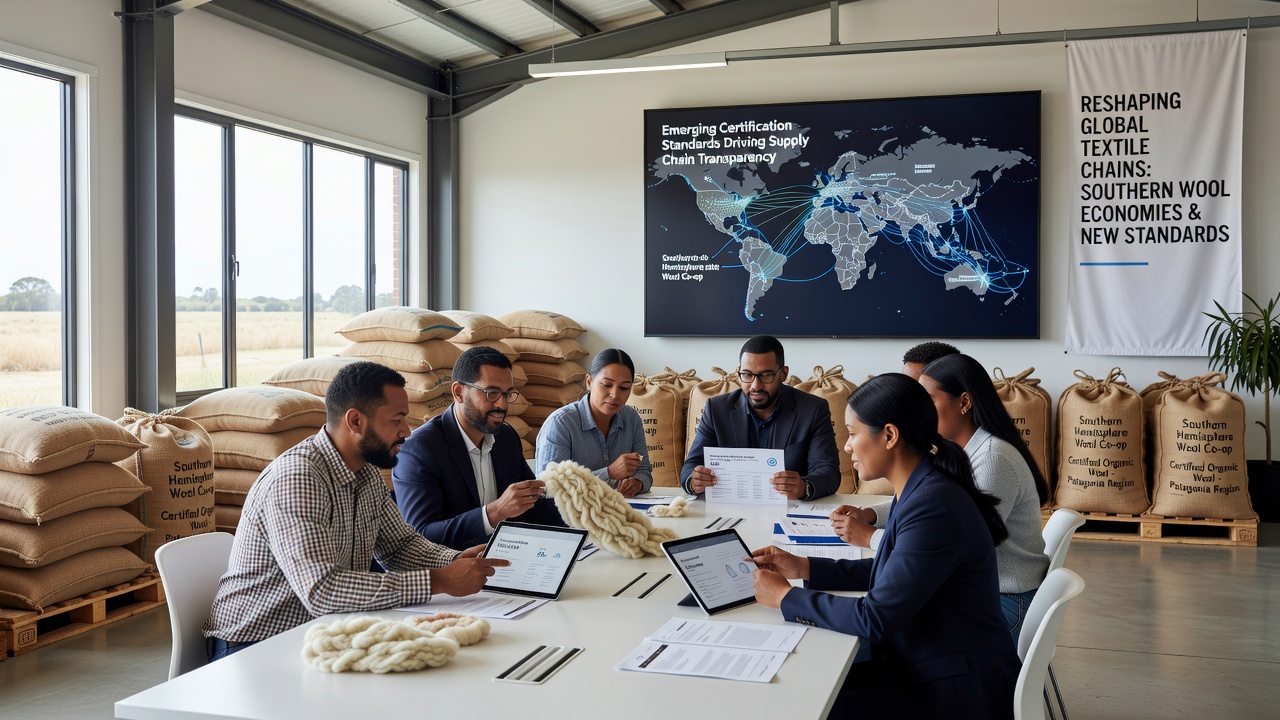
Southern hemisphere wool economies in Australia, New Zealand, South Africa, Argentina and Uruguay continue to expand their influence on global textile supply chains, and this shift stems largely from the rollout of new certification standards that prioritize traceability, environmental metrics and animal welfare protocols. These standards emerged in response to buyer demands from Europe, North America and Asia, where manufacturers seek documented proof of sustainable sourcing before committing to long-term contracts. Data from the International Wool Textile Organisation shows southern hemisphere nations supplied over 65 percent of the world's apparel-grade wool in recent seasons, yet the real transformation lies in how certification systems now dictate logistics, processing locations and inventory management across continents.
Production Volumes and Export Patterns
Australia remains the largest exporter, with annual greasy wool output exceeding 300,000 tonnes, while New Zealand and Uruguay contribute substantial volumes of finer micron wool suited to premium garments. South African and Argentine producers have increased their share of mid-micron wool used in upholstery and technical textiles. Export figures from the Australian Bureau of Agricultural and Resource Economics reveal that certified wool shipments grew by 18 percent between 2023 and 2025, and this growth correlates directly with the adoption of unified certification frameworks that allow seamless movement through European ports and Asian finishing facilities. Supply chain managers report shorter lead times when wool carries verified certification labels, because customs authorities and brand auditors accept the documentation without additional verification steps.
Key Certification Standards Driving Change
Several certification programs have gained traction since 2024. The Responsible Wool Standard, updated in early 2025, now incorporates satellite monitoring of pasture conditions adn mandatory soil carbon reporting. The ZQ traceability program, administered from New Zealand, integrates blockchain records that follow each bale from farm to spinning mill. In South America, the Uruguayan Wool Secretariat introduced a regional standard in 2025 that aligns with EU due-diligence regulations on deforestation-free commodities. Observers note that these programs share common data fields for fibre diameter, yield and provenance, which reduces duplication when wool moves between processors in different countries. Textile mills in Italy and Japan have begun requiring at least one of these certifications for new contracts, and this requirement has prompted southern hemisphere growers to invest in on-farm record-keeping systems that feed directly into export documentation.
Supply Chain Reconfiguration
Certification requirements have altered traditional routing patterns. Wool once shipped directly to China for scouring now frequently stops at certified facilities in Portugal or Turkey to maintain chain-of-custody integrity. Logistics companies have opened consolidation hubs in Melbourne and Montevideo equipped with digital tagging stations that upload data to shared platforms accessible to European retailers. Research from the University of New South Wales indicates that certified supply chains experience 12 percent fewer delays at border inspections, and this efficiency gain offsets the higher per-kilogram cost of certified wool. Manufacturers report that inventory planning has become more precise because certified bales carry predictable quality parameters, reducing the need for safety stock.

October 2026 Developments
In October 2026 the International Textile Federation published revised guidelines that harmonise data formats across existing certification schemes, and these guidelines took effect for all new contracts signed after 1 November 2026. The update introduced mandatory disclosure of methane emissions per kilogram of wool, a metric already tracked by several Australian and New Zealand producers through on-farm sensors. Early adopters in Argentina completed pilot uploads to the new platform within weeks, demonstrating that smaller operations can comply without prohibitive infrastructure costs. European brands announced they would phase out non-certified wool by the end of 2027, and this timeline has accelerated investment in certification training programs across the southern hemisphere.
Regional Adaptation Strategies
Growers in different countries have tailored their responses to local conditions while meeting common certification criteria. Australian producers expanded rotational grazing records to satisfy carbon accounting rules, whereas South African cooperatives pooled resources to install shared shearing and grading facilities that generate uniform data sets. Uruguay focused on port-side laboratories that issue certificates within 48 hours of bale arrival, shortening the time between farm gate and export vessel. These adaptations illustrate how certification standards function as both constraint and catalyst, prompting infrastructure upgrades that simultaneously improve efficiency and market access.
Conclusion
Southern hemisphere wool economies have embedded emerging certification standards into every stage of their supply chains, from pasture management through to final export documentation. The resulting systems deliver verifiable data that satisfies regulatory and commercial requirements in major import markets. As the October 2026 harmonisation guidelines continue to roll out, further adjustments in logistics and processing locations appear likely, yet the core mechanism remains consistent: documented compliance now determines which wool enters high-value textile streams and which remains in lower-margin channels. This structural shift continues to redefine relationships between growers, processors and end buyers worldwide.